

Learning how to check an AI answer can save you from repeating a convincing mistake. Imagine Alex, a fictional beginner, preparing a presentation about workplace technology. A chatbot supplies a striking statistic and names a report. The sentence looks ready to paste into a slide.
Alex opens the report before using it. The number exists, but it describes a small survey in another country several years earlier. The chatbot has turned a narrow finding into a broad claim about workers today.
This hypothetical example shows why finding a real source is only part of verification. You also need to check what it measured and whether it fits your question. This guide walks through seven practical steps, from identifying important claims to deciding what to use, correct or leave out. No technical background is needed.
Table of Contents
- The Answer Sounds Right—But What Supports It?
- Before You Act: How Much Would a Wrong Answer Matter?
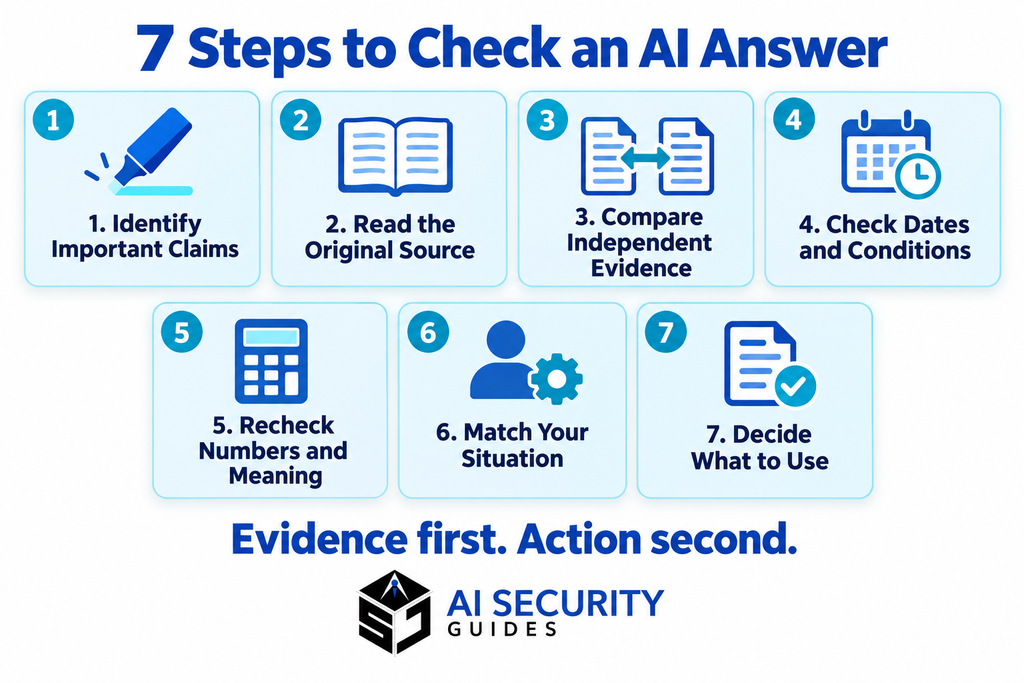
- Step 1: Identify the Claims That Need Checking
- Step 2: Find the Original Source and Read It
- Step 3: Compare Independent Evidence
- Step 4: Check Dates, Location and Conditions
- Step 5: Recheck the Numbers and the Meaning
- Step 6: Test Whether the Answer Fits Your Situation
- Step 7: Decide What to Use, Correct or Leave Out
- Let AI Help With Verification Without Becoming the Proof
- How to Check an AI Answer: Your Final Checklist
- Frequently Asked Questions
1. The Answer Sounds Right—But What Supports It?
An organised answer can feel researched even when its important details are wrong. Clear wording, confident statements and neat references do not establish accuracy.
NIST’s Generative AI Profile describes confabulation: confidently presented false or erroneous content. It also identifies fabricated reasoning and citations as risks. This is often called an AI hallucination. nvlpubs.nist.gov
Some mistakes are less obvious than invented information. A summary may remove an exception, confuse two organisations or present an estimate as a confirmed result.
Warning signs that deserve attention
Look more closely when an answer includes:
- Exact figures without a traceable source.
- Quotations without an original passage.
- Broad promises such as “always works.”
- Advice that ignores a condition in your question.
These are reasons to investigate, not proof that the answer is false. Equally, an answer without obvious warning signs still needs checking when the consequences matter.
2. Before You Act: How Much Would a Wrong Answer Matter?
Knowing how to check an AI answer starts with deciding what you plan to do with it.
A list of fictional character names needs different attention from instructions that could delete files. Spend your effort on details that affect decisions, money, safety or another person’s reputation.
For a quick first pass, identify the main claim, look for supporting evidence and check whether the context matches. Stop and investigate further if any part is unclear.
For health, legal or financial decisions, use relevant authoritative information and seek qualified help when needed. A chatbot’s response should not be your only basis for a consequential decision.
You do not have to investigate every sentence equally. However, avoid assuming that a familiar-sounding statement is correct simply because you have heard it before.
3. Step 1: Identify the Claims That Need Checking
Start with the exact answer you received. Save a non-sensitive copy if you need to keep track of later changes.
Separate facts from suggestions
“This product supports offline editing” is a factual claim. “You might find offline editing useful” is a suggestion. The suggestion still depends on whether the feature exists.
Highlight names, dates, figures, quotations and instructions. Then ask which details would change your next action if they were wrong.
Alex highlights the presentation statistic rather than spending time checking every introductory sentence.
Write each important claim as one short statement. If a sentence says a product is cheaper, faster and more secure, that is three claims to investigate.
A useful note has three fields: the claim, the evidence needed and the result of your check. Keep unsupported claims visible instead of silently treating them as confirmed.
4. Step 2: Find the Original Source and Read It
When learning how to check an AI answer, treat its references as leads to investigate.
Confirm that the source exists
Search for the report title, author or issuing organisation independently. Check that the title, date and publisher match the citation. A working link to a real website does not establish that a named report exists.
A broken link does not automatically mean a citation is invented. Try the publisher’s search or a library catalogue before marking it unavailable.
Find the passage that supports the claim
Open the source and search for the relevant phrase, figure or table. Read the surrounding text and footnotes.
For quotations, compare the exact wording. For research papers, check for corrections or retractions where available.
If you cannot access the full source, say what you could inspect. An abstract or search snippet may not contain the qualifications you need.
Alex finds the statistic in a table. Next, he reads who took part and what question they answered.
5. Step 3: Compare Independent Evidence
Choose evidence suited to the question. Official product documentation helps establish a feature’s stated requirements. An original report shows what its authors measured. Neither automatically proves every broader claim made about it.
Look beyond the first website
The Digital Inquiry Group’s lateral-reading guidance recommends leaving an unfamiliar website to see what other sources say about it. This helps you assess a publisher beyond its own description. COR
Count independent sources, not repeated articles
Five pages may all repeat one press release. Trace their references before treating them as separate confirmation.
Seek evidence that could challenge the claim as well as support it. Otherwise, your search can become a hunt for agreement.
If credible sources disagree, compare definitions, methods and publication dates. Record the disagreement rather than selecting whichever answer sounds most convenient.
For Alex, several blog posts repeat the same survey. They add visibility, but they do not expand the survey’s sample.
6. Step 4: Check Dates, Location and Conditions
An important part of how to check an AI answer is asking whether accurate information applies here and now.
Separate the page date from the evidence date
A recently updated article may discuss older research. Check when the evidence was collected, not just when someone wrote about it.
For software instructions, look for the relevant version and account type. For official guidance, check the jurisdiction and any effective date.
Readers in the UK, US and Australia should not assume that one country’s requirements apply elsewhere. Even within a country, rules and services can differ by region.
Read the limits
Look for eligibility conditions, exceptions, definitions and exclusions.
Cornell’s source-evaluation guide encourages readers to consider a source’s relevance, currency, evidence and suitability for their purpose. knight.as.cornell.edu
Alex now recognises that the survey cannot support a general statement about all workers today. Its date and population must remain attached to the finding.
7. Step 5: Recheck the Numbers and the Meaning
Use a calculator or spreadsheet to verify important arithmetic. Check the inputs as carefully as the final total.
Check percentages and units
Consider this separate hypothetical example: a rate rises from 20% to 30%. That is an increase of 10 percentage points, or a 50% relative increase. Calling it simply “a 10% increase” creates ambiguity.
For currency calculations, establish the currency, exchange-rate date and whether fees are included. For measurements, confirm the units.

Check what the evidence actually says
Ask whether the answer changed:
- A small sample into an entire population.
- An association into a claim of cause.
- A possible outcome into a guaranteed result.
- An average into something true for every individual.
Before: “The survey proves workers everywhere prefer this technology.”
After: “In this hypothetical survey, respondents from the stated group reported a preference for the technology.”
The revised wording is narrower because the evidence is narrower. Verification sometimes means changing the sentence rather than finding another link.
8. Step 6: Test Whether the Answer Fits Your Situation
When deciding how to check an AI answer, review its assumptions about your circumstances.
Does it assume you have administrator access, a paid subscription or a particular device? Has it overlooked a requirement you supplied?
Check missing steps
For practical instructions, identify prerequisites, permissions and a way to undo changes. Compare the proposed action with official instructions for the product involved.
If a test is appropriate, use a copy, sample data or a separate test environment. Do not test unfamiliar destructive commands on important files.
Check summaries against the original
Imagine Alex next asks for a summary of a work document. The response looks accurate, but leaves out a deadline exception.
He compares the summary with the relevant section and restores the missing condition. This is a hypothetical example of an answer being incomplete rather than entirely false.
Do not upload additional confidential material merely to make verification easier. Use authorised, relevant extracts and remove unnecessary identifiers.
9. Step 7: Decide What to Use, Correct or Leave Out
Verification should end with a decision, not an ever-growing collection of links.
| What you found | What to do |
|---|---|
| Evidence supports the claim and context | Use it with an appropriate reference |
| Evidence supports a narrower statement | Rewrite it to match the evidence |
| Evidence is incomplete or conflicting | State the uncertainty and investigate if needed |
| Evidence contradicts the claim | Correct or remove it |
| The action has serious consequences | Seek suitable review before acting |
Keep a short record
Record the claim, source location, date checked and remaining uncertainty. A page or table reference makes the evidence easier to revisit.
Stop when the evidence is adequate for the intended use. If you cannot establish something important, leave it out instead of giving it a confident rewrite.
Alex removes the broad statistic from his slide. He can use the original survey only if its limits are relevant and clearly explained. The presentation no longer relies on an unsupported generalisation.
10. Let AI Help With Verification Without Becoming the Proof
You can ask a chatbot to organise the checking process. That does not make its review independent evidence.
Try this prompt:
Review this answer for factual claims, assumptions and recommendations. List the important claims separately and suggest original sources I should inspect. Identify missing context. Do not invent references. Clearly state which sources you have actually accessed and what remains unverified.
If the tool cannot browse, the instruction will not give it live access. Inspect any references it proposes yourself.
Is a second chatbot enough?
A second answer can reveal a contradiction or suggest a useful question. Agreement alone does not prove accuracy: both tools may rely on similar material or repeat the same mistake.
Treat a self-reported confidence percentage as another statement to assess, not a substitute for evidence.
Keep private information out of the checking process
Read our guide to things you should never share with an AI chatbot before pasting private records into another service.
If you already uploaded something sensitive, our guide to removing personal data from AI tools explains the separate places and controls to review.
11. How to Check an AI Answer: Your Final Checklist
Before relying on an answer, ask:
- Have I identified the claims that matter?
- Have I read the supporting passage?
- Does the source support the exact statement?
- Are additional sources independent?
- Do the date, country and conditions match?
- Have I checked calculations, units and missing exceptions?
- What remains unknown?
- Is the evidence sufficient for the action I plan to take?
You now have a practical way to decide how to check an AI answer without treating every sentence as a research project.
Start with the detail that could change your decision. Follow it to evidence, check its limits and adjust your response accordingly.
For broader habits around uploads, account protection and everyday use, explore AI security for beginners. Build verification into the task before you publish, send or act.

12. Frequently Asked Questions
How to Check an AI Answer Quickly?
Start with its main claim and one appropriate original source. Some checks are quick; disputed research or consequential advice may take longer. Use a short review to identify uncertainty, not to promise complete verification.
How Can I Verify Citations in an AI Answer?
No. A citation can be invented, mislabelled or attached to a statement the source does not support. Confirm both that the source exists and that the relevant passage supports the claim.
What if the answer has no sources?
Search independently for its important claims. Ask for references as a starting point, but inspect them yourself. If a significant claim remains unsupported, avoid presenting it as established fact.
What should I do when reliable sources disagree?
Compare what each source measured, when it was published and which conditions apply. Describe unresolved disagreement clearly. For a consequential decision, seek someone qualified to assess the evidence.
Can an AI fact-checking tool replace manual review?
Use it to flag statements or find possible evidence, then inspect the supporting material. Before relying on its verdict, check whether it evaluated your exact claim and disclosed relevant uncertainty.
Which answers need professional review?
Consider professional review when applying an answer could affect health, legal rights, substantial finances or critical systems. General educational checking cannot resolve every individual situation.
This article provides educational guidance. Verification reduces avoidable mistakes but does not guarantee accuracy or replace appropriate professional advice.